A Community Vision
I-375 Reconnecting Communities
I-375 Reconnecting Communities
By centering community voices and collective memory, we’re helping transform a landscape shaped by displacement into a place for reconnection, healing, and belonging.
The I-375 project began as an infrastructure initiative aimed at repairing aging roadways. However, through collaboration with community partners, it evolved into a broader effort to address the consequences of a below-grade freeway that was built through Detroit’s historic Black Bottom and Paradise Valley neighborhoods in the 1960s. That project displaced more than 100,000 residents, many of them African American.
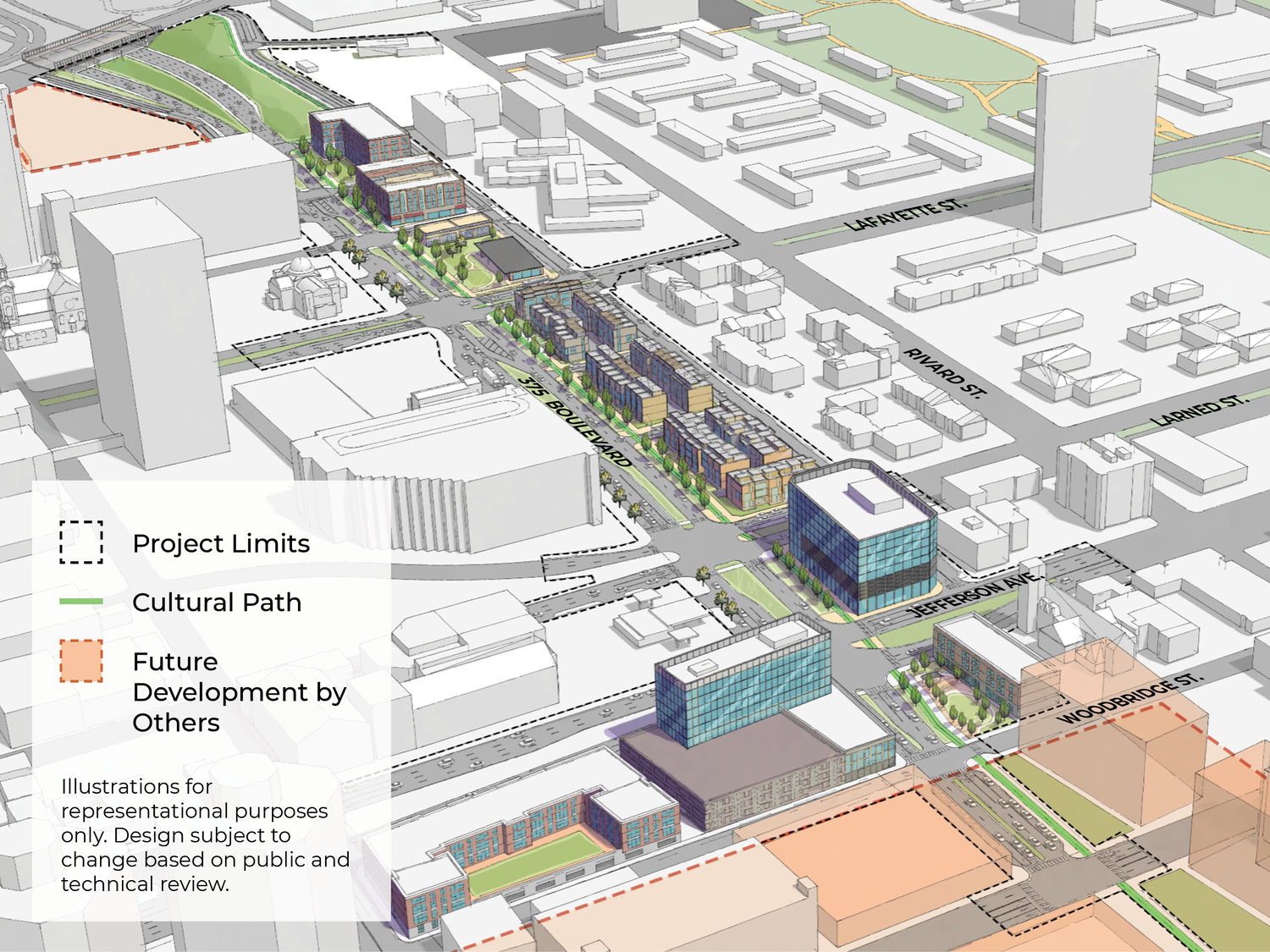
Approximately one mile of I-375 will be converted to a surface-level boulevard, which will improve street connectivity, safety for pedestrians and cyclists, and access to the riverfront. Decommissioning the freeway will also create about 8.8 acres of “excess” land.
Our task is to engage with Detroiters, and particularly those affected by the original freeway construction, to develop a Neighborhood Framework Plan for the corridor that recommends zoning and land use for the excess land, including suggestions for the size and placement of public spaces, the scale of new construction, and how the site’s history is represented through the built environment.
Our team assembled a dedicated Arts and Culture Advisory Board to guide and inform our design vision, which includes a “cultural path” integrating historical markers and public art. This important component of the plan transforms infrastructure into an anchor of identity, turning a transitional corridor into a meaningful destination.
We are embarking on a design and construction project to acknowledge mistakes made in the past and create better infrastructure for the future.


