Last week, sustainability champion, AIA past president, and Quinn Evans principal emeritus Carl Elefante was kind enough to visit our DC office and take questions about his book, Going for Zero: Decarbonizing the Built Environment on the Path to our Urban Future. The following are excerpts from that conversation.
Later in the day, Carl also participated in our panel, Meeting the Moment: Perspectives on Building Reuse. Moderated by Kathleen Lane, the American Institute of Architects’ Managing Director of Climate Action and Design Excellence, and featuring Carl, Tom Jester, Julia Siple, and Kelly Haley, the conversation covered a range of approaches toward and strategies for the renewal of existing buildings to address the challenges of our time. Look out for future posts based on the panel discussion!
On Merging Preservation and Sustainability
I came to Quinn Evans without a historic preservation background. This said, preservation was in the world around me. I went to architecture school at the end of the ‘60s; Penn Station was torn down a few years before, the National Historic Preservation Act had just been passed in 1966, so there was a lot of conversation about the importance of preservation. Yet, if you told me back then that my career would focus on historic preservation, I would not have thought it possible.
What did lead me to historic preservation? In 1994 and ‘95, I got to serve on a committee in President Clinton's Council on Sustainable Development. There were something like 700 people involved. I came out of that experience feeling like I'd just gotten a PhD in sustainability. I met experts from all around the world in every aspect of sustainability—related to the built environment and much more. For example, I was introduced to the topic of food insecurity. Who knew that food supply was perhaps the biggest sustainability challenge?
After that experience, I spent about a year talking to everyone who would sit down for an hour about what the truest version of sustainability might look like. And believe it or not, hands down, the most interesting conversation I had was with Mike Quinn. And for those of you who knew Mike: I had lunch with Mike Quinn. I'm probably one of five people in the world that Mike actually took an hour out of his day and had lunch with. That in and of itself says something about the experience.
So I came to Quinn Evans with the idea of bridging sustainability and the stewardship of the built environment from the historic preservation standpoint. The natural environment, built environment, stewardship—bringing it all together.
On Challenges to Decarbonizing the Building Sector
In practice for most architects, most clients, most projects, tackling climate change is still an emerging issue. It still feels like a new problem for architects to address.
I may be the only person in the room who remembers when ADA [the Americans with Disabilities Act] was passed in 1990. All of a sudden, there was a new mission for architecture: buildings needed to be accessible. And especially as stewards of historic buildings, that was a big problem—there are a lot of steps in historic buildings! So having a new mission is something that is not foreign to architects at all. There’s a lot to be said about this kind of evolution, of architects adding new considerations. There was a time when fire codes were a new thing.
Many foundational principles for carbon accounting don’t address the building sector directly. The definitions of scope one, two, and three emissions were not written for architecture, they were written for industry. With buildings, carbon accounting must consider design, construction, and operation. Implementing decarbonization in the building sector is a little bit of a misfit with how carbon accounting for industry and the energy sector were designed. Although we actually have a practical approach to building-sector decarbonization, it can be difficult to communicate it to people in other fields.
Many systems affect buildings, like building codes, zoning codes, financing of architectural projects, the monetary value placed on carbon pollution (none). Almost every one of those systems actually makes it harder for us to design sustainable buildings, not easier. Well, that's not okay. Let's get mad. Let's get grumpy!
On How Architects Can Take Action
I’ve spent a lot of my career getting to do things in addition to the projects on my desk. I know that in our field it’s very hard to have any brain space at all for anything but what you're doing today. AIA is a community of 100,000 architects. This is the “army” that must fight the battle, whatever it is. Understanding that made me want to rally the troops, to help architects understand that although we have some big, big challenges to face, each is ultimately an enormous opportunity.
Our profession is right in the middle of every issue. How do we think about the projects on our desk as a way to help solve those big challenges? With our roots at Quinn Evans in historic preservation, we understand what it looks like to practice architecture in a different way.
For example, take a look at building codes. Building codes are requirements, right? Are those requirements the requirements we most need? The building code now has chapters about existing buildings and equivalencies and things like that. Good. But, what would a building code chapter look like that truly optimizes durable construction and long-term value? That talks about flexibility and adaptability in buildings? That shows how to make buildings that continue the lifecycle of long-durability materials? That makes buildings which maintain their lifecycle value? Right now, building codes completely ignore these issues. That's a systemic change we can start to work on.
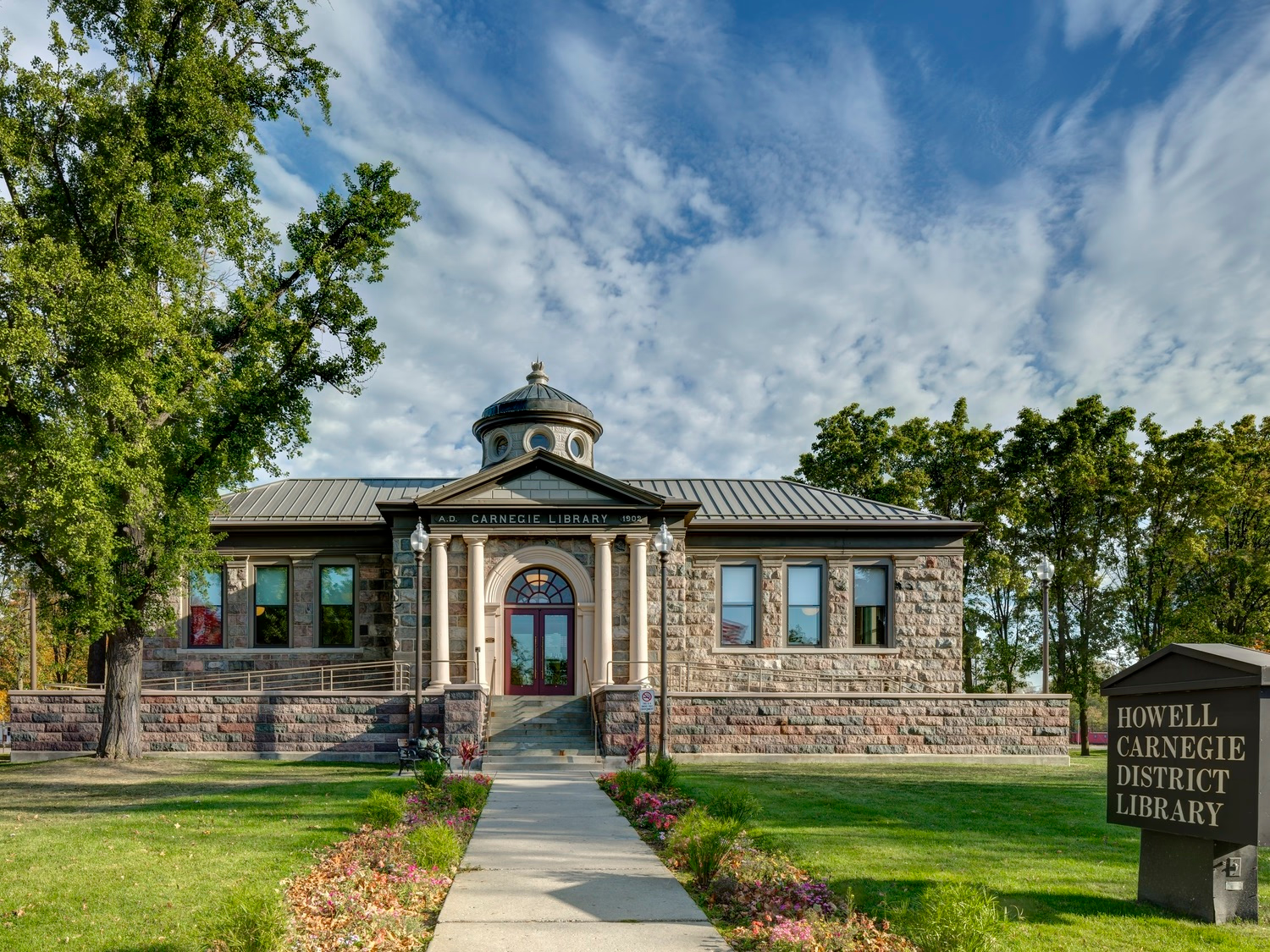
In our complex and highly collaborative field, it is easy to lose sight of our ability to make systemic change—but it is there to seize. Let me give you an example close to home. When I was searching for the truest form of sustainability and I had that lunch with Mike Quinn, Mike told me about growing up in Michigan. Every summer his family would go up to the lake country in upper Michigan, an idyllic world of small towns that Mike just loved. During his adolescence, those small towns fell on hard times. The Traverse City Opera House, just to use one example, got boarded up. As young men, Mike Quinn and David Evans were driven to do something about it. “We're architects. We couldn't just let that lie.” They devoted their lives to getting the boards off the windows of the places they loved in Michigan.
It’s not rocket science and it doesn't have involve something from afar. It can be in the world that you’re already a part of where your ability to make a difference is biggest. Look at the difference that Mike Quinn and Dave Evans made. It's inspiring how they reversed the trends that they saw as teenagers which were making the world worse, and turned them into things to make the world better.