Daylighting Design for Circadian Health: Insights from Case Studies
JULIA SIPLE
The opportunity for incorporating health and wellness really leads to a sense of community, belonging, safety, and health.
DENISE GRAVELLE
The goals of the research were to really understand what design impacts that we can have as architects to influence circadian health within the built environment, particularly within existing buildings.
JULIA SIPLE
Case studies were really important to our research process because we were studying the different design strategies for circadian health in, first, kind of a simple box model and using daylight modeling tools to help evaluate which of those strategies had the most impact.
But after looking at it in kind of like a non-real-world scenario, we wanted to think about how this applies to actual projects and actual renovation of existing buildings.
So, we picked three projects that we had already worked on and wanted to understand, looking at before-and-after scenarios, how much our design improves circadian health, and to reflect and think about which strategies were the most impactful for circadian health or if there were any opportunities that would have continued to make that building perform better for daylight and circadian health.
DENISE GRAVELLE
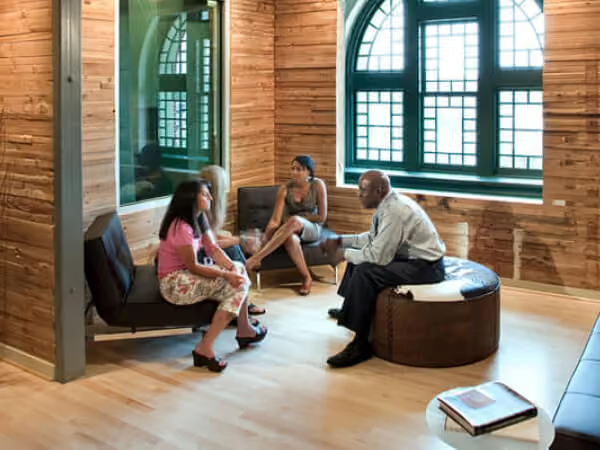
Old City Hall in Richmond, Virginia, is a building that was really important for us to study because it's an example of historic preservation. So, we really wanted to study a building where there were more constraints around the envelope of the space.
It had smaller windows on the façade that didn't allow in as much daylight. But because it's a historical building, we don't have an opportunity to punch bigger holes in the façade to let in more daylight.
So, we had to look at design interventions that were really more on the inside of the space to see how they change the daylighting levels within the building. And we found that just through things like white paint and brighter finishes within the space dramatically improve the circadian daylighting exposure for the occupants of the building.
JULIA SIPLE
Office and school are two of the most important project types for circadian health, because it is space that people spend a large portion of their time indoors. And so the access to daylight and access to quality and healthy spaces really has an opportunity to make the greatest improvement to performance of people in those spaces.
.avif)